Showing posts with label Algebra. Show all posts

Monday, March 4, 2013

Algebra and the Party People Help Teach Greatest Common Factor

I was substituting in third grade today.  They had a quiz involving lowest common factor and greatest common factor.  I remember being so confused by these terms.  I asked the kids if they wanted a silly story to help them to figure out these terms.  They said yes, so we decided that the letters in GCF, or greatest common factor, stood for greatest celebration forever.  If you are having a great party, you would need tables.  Right?  So, I showed them the T factoring table.


        If the want to find the greatest common factor of the numbers,

 12 and 16, you would have the kids draw their "party" tables.  The play on the word tables helps us left-brained people.  Just have them always number the left side of each table 1-8. 
     Factors are the two numbers that are multiplied together to make another number.  In the table on the left 1 x 12 =12, 2 x 6 = 12, 3 x 4= 12, 4 x3=12, 5 is not a factor of 12, and 6 x 2=12.   
      The table on the right factors the number 16 in the same way.
       Then I ask the kids if there is a number that is the same in each table.  The number in common to both tables is 4.  Because we are starting with the 12 and 16, and doing the tables in this manner, the number in common will be the GCF.

After we did several of these, I could see the lightbulbs going off in a lot of their heads. 

I have been doing these tables in Algebra (see Who Let The Dogs Out post), so you know that this is going to be a very handy tool for math here.


Thursday, October 11, 2012

Algebra and the Skiing Cat Who Helps you with Negative Fractions


Algebra uses fractions a LOT.  You need a fraction in the slope equation to graph an equation.  In a previous post on slope that you can see  at Treasure Maps and Graphing Slope     the skiing cat above will help, I hope, in helping kids use negative fractions while graphing. 
      I explained that in the equation y = mx + b, or y = 2/3x + 8 for example,  that the +8 (or b value) represents the point on the graph (treasure map) where the pirates parked their boat. B is for boat I tell the kids. I tell the kids that it is a banana boat which is yellow. I always had them color their y axis yellow when graphing.  It helped reinforce which axis is the y,  which left-handed kids seemed to be confused about.  I had them color the x axis brown, like the ground.
     Once they had parked the boat at the b point, they used the fraction in front of the x (the m) to go looking for the treasure.  So, they went up two and over three in the example above to find the second point.
    
     But, what happens if there is a negative number in front of the fraction. We left-brained people can't seem to remember whether it goes with the numerator or with the denominator.  This makes a big difference as to what direction the pirates go searching.  They could be going south or down if it is a negative numerator.  They could be going left is it is in the denominator.  
     So, since I had already used a ski slope to explain using two sets of points to find slope here
I thought we could build on this idea.  If the students could be taught to recognize the negative sign as "catski," then they would recognize also that it doesn't matter if the negative sign goes with the numerator or the denominator because....

-a  = a
b    -b


The explanation could be that the negative sign is really a skiing cat's tail.  Tell the kids he uses it like a map to tell him which way to turn on the slope (like the pirates do while looking for treasure).  If he uses it to help him go down the mountain (-a value) or he uses it to go left on the mountain (-b value), he still always ends up on the same slope at the bottom of the mountain. 

Once you've done several slope equations with negative fractions, and the kids realize the points on the slope might change, but that it is still the same slope, they will relax when they see the negative fractions.  They might even want to go skiing.

Thursday, September 27, 2012

Algebra and Mixed Numbers


    I found this question in one of my Algebra review books.  Because it had the numbers in different forms, I was immediately drawn to it and wanted to figure it out.  Because Algebra likes to simplify equations and expressions, and make things uniform, this was a good example of changing all the forms to the same standard.  The question asked the students to put these numbers in least to most order.      


                   5/8,  2.5 x 10⁻¹,  150%,       


 I started by thinking of the numbers as people in line waiting to buy something.
  
 I don't know about you, but as a left brained person, this looks like GREEK to me.  But, if you notice, two of the numbers actually are "calling out" to you to convert them to decimals.  
  In a previous post entitled Left is for Lollipops and Right is for Rats I explain how to turn numbers into scientific notation.  You can use that concept in reverse to change numbers back into decimal form.
  Let's start with the   5/8.  By fourth grade, students have learned this concept.  Simply divide the numerator by the denominator.    This gives the result of .625  

  Let's go to  150%.  Changing percents to decimals is as easy as remembering that each of those 0's in the percent symbol represents a place to move the decimal.  There are two zeros, so we are going to move the decimal two places.  But, the left brained student is thinking, which way do I go?  Which way do I go?  Remind them that if they were in a STORE buying something, and it was on sale, they'd need to get to the front of the line to buy it.  So, move the decimal (you) two spaces to the front of the line.  The result is 1.5.  Try this with 30 %, which they see sale signs for a lot.  Move the decimal two places to the front of the line, and you get .30. ( I usually do ten percent in my head, then triple that.)

Let's move on the the number  2.5 x 10⁻¹
Review the scientific  notation post.  Since this number is already in scientific notation form, we will do the OPPOSITE to convert it.  Since we were already RIGHT with our negative exponent, we will go LEFT to convert it.  We are moving our decimal 1 place because our little road sign says "exit 1 to the right."  So since we are going LEFT, we are moving the decimal 1 place to the left with the result being .25.

  Oh, my goodness, doesn't that square root look scarey?  If it was the square root of four, you'd automatically think 2.  If it was the square root of 9, you'd automatically think 3.  But, what double times itself results in 2?  Hey, it's been a long time.  I don't have a chart.  I  Googled it.  The answer is 1.414....

So the answer to the question of putting them in order from least to greatest is

.25,  .625 , 1.414 , 1.5.

I have always reminded students that decimals are used most often in their lives for money.  If they look at the terms above as money, they are easy to read.


Sunday, May 20, 2012

Algebra and Let's Play Baseball with FACTORING

 I have done two previous blogs on factoring and foiling with trinomial equations.  Today we are going to go all the way around the "bases" and do an equation using both methods.  We are going to begin with multiplying two factors together.  
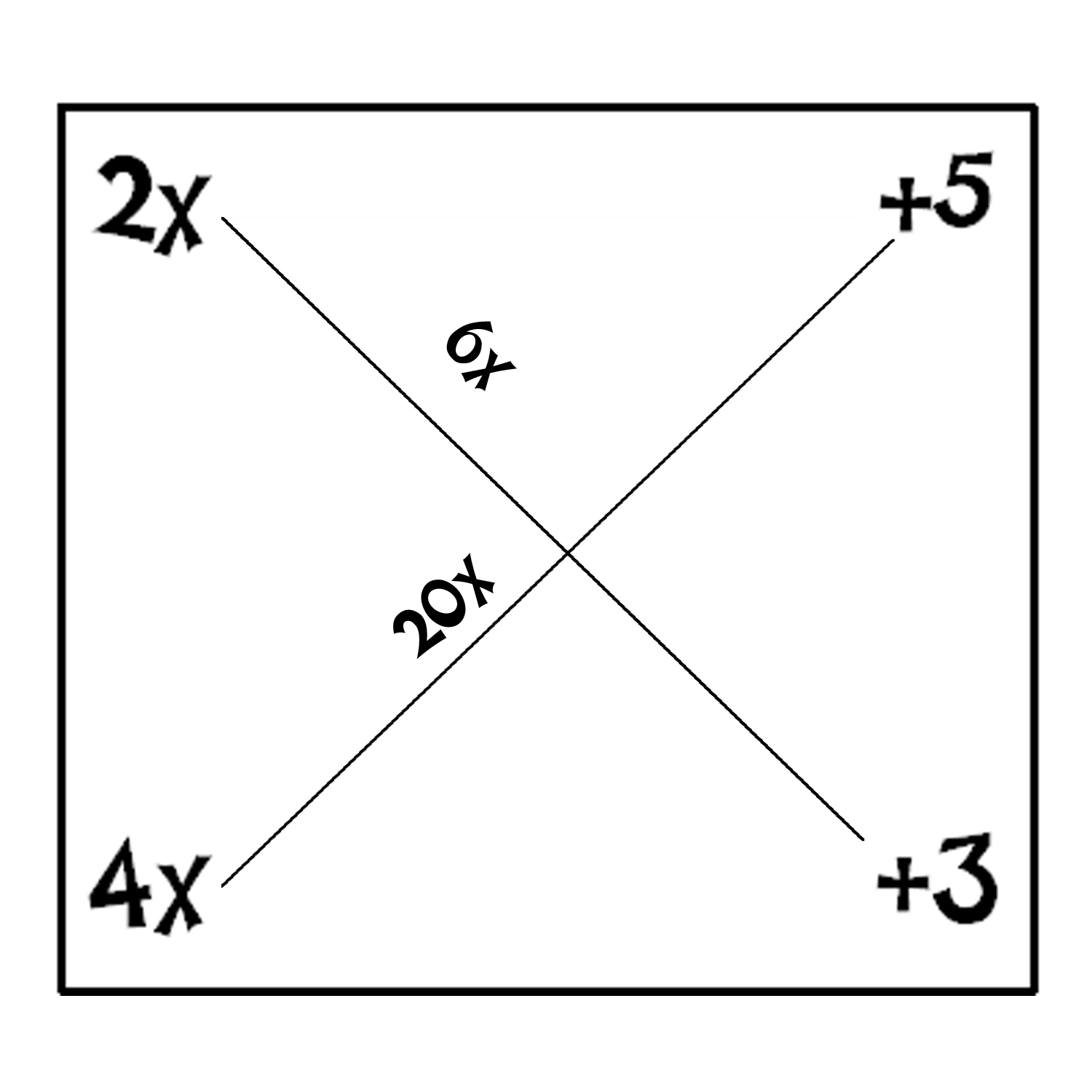
The example is:   (4x +3)(2x + 5).

I am going to remind you that visual learners will find this "baseball" lineup hard to work with.  It doesn't look like a regular multiplication equation with more than two digits.  So let's line it up so that it looks easier to work with.
                   
            (2x + 5)
                 
            (4x + 3)  This step is very important.  Having the kids mark it with a red X will help them visualize what needs to be cross multiplied.

Because we are going with the baseball theme, I am inserting the baseball diamond below, even though it looks like a square with an X in the middle.  Of course, if you were drawing it, making the X in the middle red would emphasize the factors above.
I put the X's on the left side and the numbers added to them on the right side.  It is important that the numbers in each factor (   )  are connected along the same line as the box.  See how the 2x is on the same top line as the 5, and the 4x is on the same bottom line as the 3.

Now, we go back to the "Yes, MAM, I can foil."  The MAM stands for Multiply Add Multiply.
(I used a girl pitcher to reinforce idea of "MAM." Or you could tell the kids the coach is a lady.)

                                            So, the result of this inning is  
                        8x2 + 26x + 15


But, we're not done.  Now we are going to complete be re-factoring the equation using our Who Let the Dogs Out method. (slide and divide) 
   1.   Remove the 8 from in front of the  x2     
   2.   Multiply the last number in the equation by 8 to get 120.
    3.   Leave the middle variable ALONE.
    4.   The new equation is: x2 + 26x + 120
    5.   Put the dog dishes out and put a bone (x) in each one:  ( x +      ) ( x +      ).
    6.   Because the equation has two positive numbers (important) you can put a + sign in each             bowl (set of parenthesis). 
    7.   Make your 1,2, 3 factoring chart.   Factor 120.    
                           
                              
    8.   As you can see from the chart, the only combination that adds up to the middle variable 
           of 26 is the 6 and 20. (See previous blog of factoring if you don't understand this).

    9.  So, the new factors are  (x + 6) (x +20).  Normally you would put the 8 back into the 
         factors here by dividing 6 and 20 each by 8.  But you can see that neither number is 
        evenly divided by 8.  So, you must put the 8 back in front of each x.  This results in the 
        following factors:  (8x + 6) (8x + 20).
  
  10.  Finally, back to factors, but they're not the same ones we started with.  What to do?
         Can we reduce each factor separately by dividing by the same number?  YES!!!
         (8/2x + 6/2) = (4x + 3)
         (8/4x +20/4) =(2x + 5)   (Do you see that each factor was divided by a DIFFERENT 
         number.   

          WE JUST MADE IT ALL AROUND THE BASES 
                          FOR A HOME RUN! 


Wednesday, May 16, 2012

Scientific Notation


    When my visual learning daughter was in high school, she had trouble learning scientific notation.  This is the conversion of LARGE NUMBERS to smaller numbers with exponents.  She could never remember which way to move the decimal and whether the exponent was a positive or negative.
     So I explained it to her using lollipops and rats.  The word lollipop starts with an l as does the word LEFT.  Lollipops are also a positive thing. The word rat starts with an r as does the word RIGHT.  Rats are usually a negative thing.  (Don't be fooled with the cute picture above.  He was just a cute image to get to this blog about MATH). 
    So, I told her the story about how a scientist is taking notes in shorthand to count MILLIONS of cells.  He was driving to the lab one day on the highway.  He noticed that the exit signs were placed on the road name signs on either the left (for a left hand exit) or on the right (for a right hand exit).  He compared this idea to exponents and was excited about explaining this to his class of future scientists.                                 

     So the next day in class, he used the number 7,854,000,000. as and example.  He told them that to convert this number to scientific notation, you must first recognize this number is a POSITIVE number. " Pretend that it is money," he told them.  They practiced and practiced just recognizing that the decimal at the end of the number made the number positive.  Next, he told them that to convert the number, they would have to place or move the decimal between the front or first two digits.  They were to pretend that they were turning LEFT off of the highway.  On the way to their destination, they saw a LOLLIPOP store.  Since this was such a POSITIVE idea, the exponents would also be positive.  Hence, the catch phrase, "LEFT IS FOR LOLLIPOPS."  So, the result of this conversion is:                  7.8 x 10⁹  
The exponent is nine because we moved the decimal point nine places.  It is positive because we went left past the lollipop store.

  The following day, he used the number  .000034  as an example.  He reminded them that they must recognize this number as a NEGATIVE number in exponents because it is smaller than 1.  In order to convert this number, they had to turn RIGHT off of the highway.  On the way to their destination this time, they saw a RAT.  Since this was such a NEGATIVE idea, the exponents would also be negative.  Hence, the catch phrase, "RIGHT IS FOR RATS."  So, the result of this conversion is:
                                
                         3.4 x 10⁻⁵

The exponent is -5 because we moved the decimal point five places to the right.  It is also negative because we went RIGHT past a RAT.


Monday, May 14, 2012

Factoring Trinomials with "Who Let the Dogs Out?"


                             3x2 + 4x + 1 

This equation might look scary.  You're asked to factor it and don't even know where to start.  We're going to refer to this problem as "who let the dogs out?" for our visual learners.  They need to focus on the number/digit in front of the x2  

Teachers in school normally refer to this method as slide and divide, but we are going to start looking specifically at the number in front as the number of dogs you let out of the house.


Kids need to review lots of equations like this one and simply tell you how many dogs they are letting out.

7x2 + 32x - 15 would involve  7 dogs getting let out.

2x2 – 5x +3 would involve 2 dogs getting let out.

(Give them LOTS of examples to just LOOK at and tell you the number of dogs they let out. What we are REALLY doing, is removing that number temporarily from the equation.  We will put it back after we factor.

 3x2 + 4x + 1 ,
 when you let out the three dogs, the resulting simplification looks like the one here:  

 X2 + 4x + 3
  When you take the number away from the X2  , the number on the end (1) must be multiplied by the number of dogs (3). You don't need to do anything yet to the middle variable. This is what teachers refer to as sliding.  You are sliding the number to the end of the equation and multiplying it to the last number in the equation.
(Do LOTS of these).


In the equation:    7x2 + 32x - 15 
  the result is :        X2 +32x -105

because we multiplied -15 x 7 = -105 (remember the number with the sword (negative sign) wins. See Dark Vadar blog.


In the equation:    2x2 – 5x +3
the resulting simplification is:  X2 -5x + 6
because we multiplied 2 x 3 to get +6 when we let the dogs out.


I am using happy sans font to make this seem more fun.


The next steps are called " The 1, 2, 3 of Factoring."
Under the simplified equations, have the kids automatically put the two factoring signs on their papers.  We'll call them the DOG BOWLS.  Tell the kids that the x represents the number of dog bones.  Have them put a bone in each bowl.           
 
                    (x      )  ( x     )

Because we've let the dogs out, each simplified equation begins with X2   
      so you can just put an x in each bowl.

Isn't this getting easier?

Now...the 1,2,3 of Factoring.  The number that needs to be factored is the last one in the equation. 

In this last equation:  X2-5x + 6   you start factoring 6 by making a 1,2,3 chart like this:
                                                                 

  These are the first three multiples of 6.  One of these combinations most likely will work in the factoring because it is a small number. Larger numbers will require you to go higher than the 1,2,3, but this is a good first step to remember.

 NOW...ta da... look at the middle variable.
It is -5x.  Of the three pairs, when the numbers are added or subtracted, the result must be -5.  Because it is a -5, you would choose the 1,6 combination--making a -6 and 1 as the factors. It is safe to always give the larger factor the negative sign.  When you combine those two numbers, the result is -5. 
                                (x -6) (x +1)    


In this equation: X2 + 4x + 3   you would be factoring 3. 
There is only one possibility  1,3.  No need to worry about negative numbers because the middle variable is positive.
 
                         (x+3) (x+1 )               

 In the equation:  X2 +32x -105, the factoring chart looks like this.  Note that 105 is not evenly divisible by 2, so it is not a factor.
                              
   Because I am looking for a combination that makes +32, I choose the third pair on the list.  35 -3 = 32.
     ( x+35)(x-3) 

Practice lots of these before letting the dogs back into the house.

You know those dogs HAVE to come back in the house.  So you need to bring the number back into the equation by dividing.  You need to divide the number in each "dog dish" or factor by the number you took out.

  In the equation  3x2 + 4x + 1  the factors were (x+3) (x+1 ).  
  So we have to divide 3/3 and 1/3.  Since 3/3=1 the first bowl  and the second bowl is 1/3 (x+1) (x+1/3 ).  You can NOT have a FRACTION as a factor.  When the number is not divisible evenly, you simply put the number you divided by in front of that x in the "bowl" or factor.  So the final factors would be (x+3) (3x+1 ).  

In the equation 7x2 + 32x - 15  the factors were ( x+35)(x-3).
So we have to divide the 35/7 and the -3/7 to get  ( x+35)(x-3).. You can NOT have a FRACTION as a factor, so the result is( x+5)(7x-3).

In the  equation 2x2 – 5x +3 the factors were (x+3) (x+1 ).  
So we have divide the 3/2 and the 1/2 since we let two dogs out.  Since both would result in fractions the final factors would be (2x+3) (2x+1 ).


                       Who Let the Dogs OUt?  Why you did.


Wednesday, April 11, 2012

Means, Ranges, and Medians, and Mode


    Visual learners need "silly" things to help them learn.  I was subbing in a third grade GT class, when this math subject came up.  Even some of those kids were looking lost.  I gave them a silly story to help them remember each term.  Let's start with RANGE.  The first thing,  I told them, was to think of a song with the word RANGE in it.  Of course, they answered, "Home, Home On The Range." 
    "What is an animal you'd most likely see on a range?" I asked.
    " A cow," they all replied.
    So, think of the numbers you have to find the RANGE for as cows.  Line up all the cows to come in for milking time.  Put the smallest ones first, as they are the hungriest.  Put the largest ones last.  If given the numbers 2, 18, 4, 9, 1  then the new order for these would be: 1,2,4,9,18.  (Putting them in order is the most important concept).  Then just subtract the smallest cow (number) from the largest cow (number).  In this example it is 18-1.  The RANGE is 17.  


   The second concept is MEAN.  I suppose it's not nice to call a teacher "mean," but we've all done it when he/she pops a test on us.  So, I use this as a way to teach the concept.  I tell the kids that the MEAN teacher is giving us a test.  I want to figure out what I need to get on this test to keep my grades up, or just to find out what grade I already have.
My past tests scores were:  84 + 60 + 74 + 90 .  They total 308.  I divide by the number of tests. 308 divided by 4  equals a 77 (because I had scores from 4 tests).  I need to study a little harder. 
   In the top (cow) example, the mean is 1+2+4+9+18=34.  Divide this by 5 tests to get: 6.8


  The above photo is of a  highway MEDIAN.  The kids have all seen these.  Show them the picture.  Remind them that it goes right down the middle of the road.  Just like this highway median, a math median goes right down the middle of the numbers. Using the cow numbers because you must also put them in order to find the median, you have
                               1,2,4,9,18   the median is 4 which is the number in the middle.

  If the numbers, for example were 13, 18, 13, 14, 13, 16, 14, 21, 13 ,  you would put them in order as 13, 13, 13, 13, 14, 14, 16, 18, 21.  Counting in from both sides to the middle (or median in the road) the answer is 14.

 Finally, the mode.  I tell the kids that MODE means the most.  In punk rock terms, this guitarist might say "MO."  As in "I want some mo of that."  I don't know why this sticks, but it is just silly enough for them to remember.    In the numbers 1,2,4,9,18 this is no mode because none of the numbers are repeated.  In the numbers 13,13,13,13,14,14,16,18,21 The number 13 shows up "mo" than the others, so it is the mode.